


• KSEBM
  • Contact us
  • E-Submission
ABOUT
BROWSE ARTICLES
EDITORIAL POLICY
FOR CONTRIBUTORS

Page Path

4
results for

"Hyun Kang"

Filter

Article category

Keywords

Publication year

Authors

Funded articles

"Hyun Kang"

Original Article

Interpreting patient values and preferences in clinical practice guideline development: distinguishing reliance on physician judgment from treatment outcome preferences – an exploratory multicenter study in patients with anal cancer
Hyo Seon Ryu, Jung-Myun Kwak, Kil-Yong Lee, Dalyong Kim, Dong Hyun Kang, Heather Swan, Hyun Jung Kim
J Evid-Based Pract 2026;2(2):98-106.   Published online September 29, 2026
DOI: https://doi.org/10.63528/jebp.2026.00015
Background
Patient values and preferences are important in clinical practice guideline development, but responses indicating reliance on physician judgment may be difficult to interpret. We examined whether such reliance can coexist with explicit preferences about treatment outcomes and trade-offs.
Methods
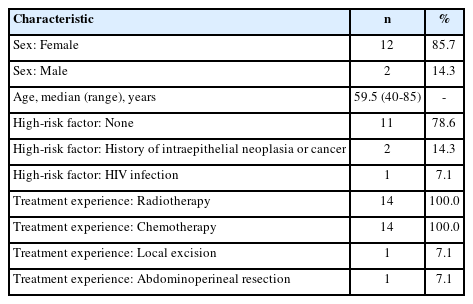
We conducted an exploratory secondary analysis of a 22-item cross-sectional survey completed by 14 adults with anal cancer recruited from four hospitals during guideline development. The survey assessed decision-making participation, responses to specific clinical scenarios, rankings of six treatment goals, and treatment-acceptance thresholds. Ten scenario items included the option “I would follow my treating physician’s judgment.” Analyses were descriptive and emphasized within-participant response patterns.
Results
Ten participants (71.4%) generally preferred shared decision-making, yet 11 selected physician judgment in at least one scenario. All 11 completed a full ranking of treatment goals, and 9 completed both trade-off threshold items. Among seven participants who relied on physician judgment for salvage treatment, all completed the ranking and six completed both thresholds; five required at least a 20% survival improvement to accept surgery resulting in a permanent stoma. Although permanent stoma ranked fourth among six goals overall, 11 of 13 respondents required at least a 20% survival improvement to accept such surgery.
Conclusions
Reliance on physician judgment did not necessarily indicate an absence of patient preferences. Guideline-related preference studies should distinguish preferences for the decision process, general priorities among outcomes, and context-specific benefit-risk trade-offs. Responses indicating reliance on physician judgment should not automatically be treated as “no preference” or missing information.
  • 134 View
  • 2 Download

Review

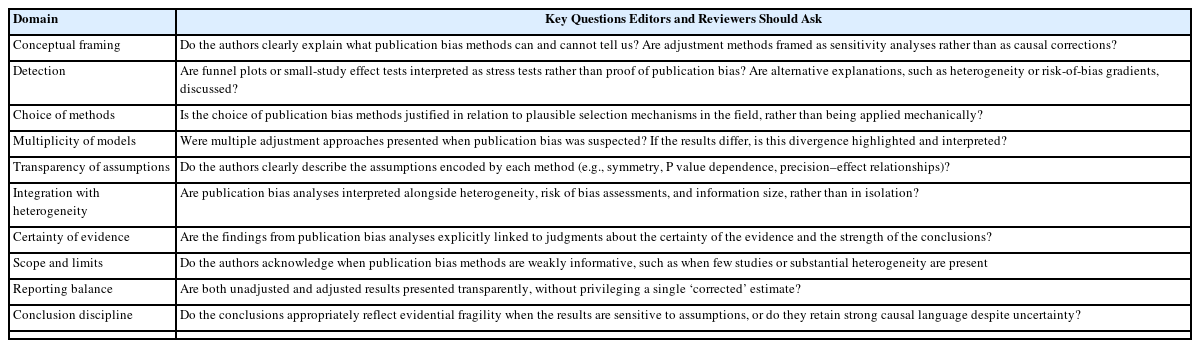
Publication bias is a fundamental threat to the validity of systematic reviews and meta-analyses in clinical medicine. Yet current practice often reduces its assessment to the mechanical application of funnel plots, asymmetry tests, or single adjustment procedures, with limited attention to the underlying assumptions, alternative explanations, or implications for evidence certainty. This narrative methodological article reframes publication bias assessment as an interpretive and editorial responsibility rather than a purely technical problem. We examine what commonly used methods can and cannot reliably support. Detection tools function as nonspecific stress tests that identify deviations from simplified models; they do not diagnose selective publication but highlight situations in which the underlying assumptions require closer inspection. Adjustment approaches, including trim-and-fill, selection models, and regression-based methods, generate hypothetical estimates under unverifiable assumptions**, and therefore provide** sensitivity analyses rather than corrections that recover the true underlying effect. Divergence across adjustment methods is particularly informative, signaling inferential fragility rather than analytical failure. We identify five recurring misinterpretations encountered in peer review: equating asymmetry with proof of publication bias; privileging bias-adjusted estimates as inherently more credible; relying on a single adjustment method without examining assumption dependence; ignoring the plausibility of adjustment direction and magnitude; and overlooking implications for certainty of evidence. Editors and reviewers should prioritize transparency of assumptions, seriously consider alternative explanations, and calibrate conclusions proportionately. Viewing publication bias assessment as an interpretive responsibility rather than a methodological checklist promotes more disciplined inference and strengthens trust in clinical evidence synthesis.
  • 227 View
  • 3 Download

Case Report

General anesthesia with remimazolam in a patient with leigh syndrome: a case report
Young Ki Kim, Dong-Hyun Kang
J Evid-Based Pract 2026;2(2):107-111.   Published online September 29, 2026
DOI: https://doi.org/10.63528/jebp.2026.00005
Background
Leigh syndrome is a mitochondrial disorder in which impaired oxidative phosphorylation causes progressive neurologic damage. Brainstem lesions may cause central hypoventilation, apnea, and recurrent pulmonary infection, increasing perioperative risk.
Case
We describe a patient with Leigh syndrome who had chronic central respiratory dysfunction, recurrent pneumonia, and a recent intensive care admission for sepsis and who subsequently underwent tracheostomy under general anesthesia. Anesthesia was induced and maintained with remimazolam and remifentanil. Hemodynamic parameters remained acceptable neuromuscular recovery, spontaneous ventilation remained inadequate, and the patient was returned to the intensive care unit with ventilatory support.
Conclusion
In mitochondrial disease, propofol warrants careful consideration because of concerns regarding mitochondrial effects and propofol infusion syndrome. Remimazolam was selected based on severe respiratory vulnerability, recent multiorgan illness, and the anticipated need for postoperative ventilatory support, rather than as evidence of superiority over other agents.
  • 120 View
  • 1 Download

Review

Beyond the paywall: the role of preprints in overcoming publication bias
Hyun Kang
J Evid-Based Pract 2025;1(1):7-11.   Published online March 31, 2025
DOI: https://doi.org/10.63528/jebp.2025.00002

Preprints have become a transformative tool in scientific communication, addressing critical challenges of traditional publishing, including long peer-review timelines, high costs, and systemic publication bias. Publication bias, which disproportionately favors studies with positive or statistically significant results, undermines the comprehensiveness and accuracy of the scientific record. By offering an open platform for sharing all research findings, preprints ensure that studies with null or negative results are also represented, mitigating the selective publication that skews research fields and meta-analyses. The COVID-19 pandemic highlighted the importance of preprints, as they facilitated the rapid dissemination of urgent findings while maintaining accessibility. Unlike traditional journals, preprints bypass lengthy review processes, enabling immediate access to data and fostering timely feedback, collaboration, and application. This inclusivity and transparency enhance trust in the research process while democratizing access to scientific knowledge. Despite their advantages, preprints face challenges, such as inconsistent quality standards, discrepancies between preprints and final publications, and risks associated with unverified findings. These challenges can complicate their use in systematic reviews and evidence-based medicine, requiring careful consideration and handling.This paper explores the interplay between preprints and publication bias, detailing how preprints can reduce bias while identifying limitations that must be addressed.

Citations

Citations to this article as recorded by  
  • Correcting what cannot be corrected: rethinking publication bias analysis methods in clinical meta-analyses
    Hyun Kang
    Korean Journal of Anesthesiology.2026; 79(3): 271.     CrossRef
  • Open Science Practices in Systematic Reviews From 2014 to 2024: A Cohort Study of 300 Systematic Reviews
    Kenneth Färnqvist, Patrik Karlsson, Vera Wachtmeister, Patrick Vallance, Emma Sinervo
    Cochrane Evidence Synthesis and Methods.2026;[Epub]     CrossRef
  • Beyond the funnel plot: editorial and reviewer perspectives on publication bias in systematic reviews and meta-analyses in clinical medicine
    Hyun Kang
    Journal of Evidence-Based Practice.2026; 2(2): 45.     CrossRef
  • 2,350 View
  • 16 Download
  • 3 Crossref
TOP